Vibe Coding Best Practices: The Complete Guide for 2026
So you've heard about vibe coding. Maybe you've tried it. Maybe you typed something like "build me a todo app" into Cursor or Lovable, watched the AI spit out hundreds of lines of code, and thought— okay, this is either

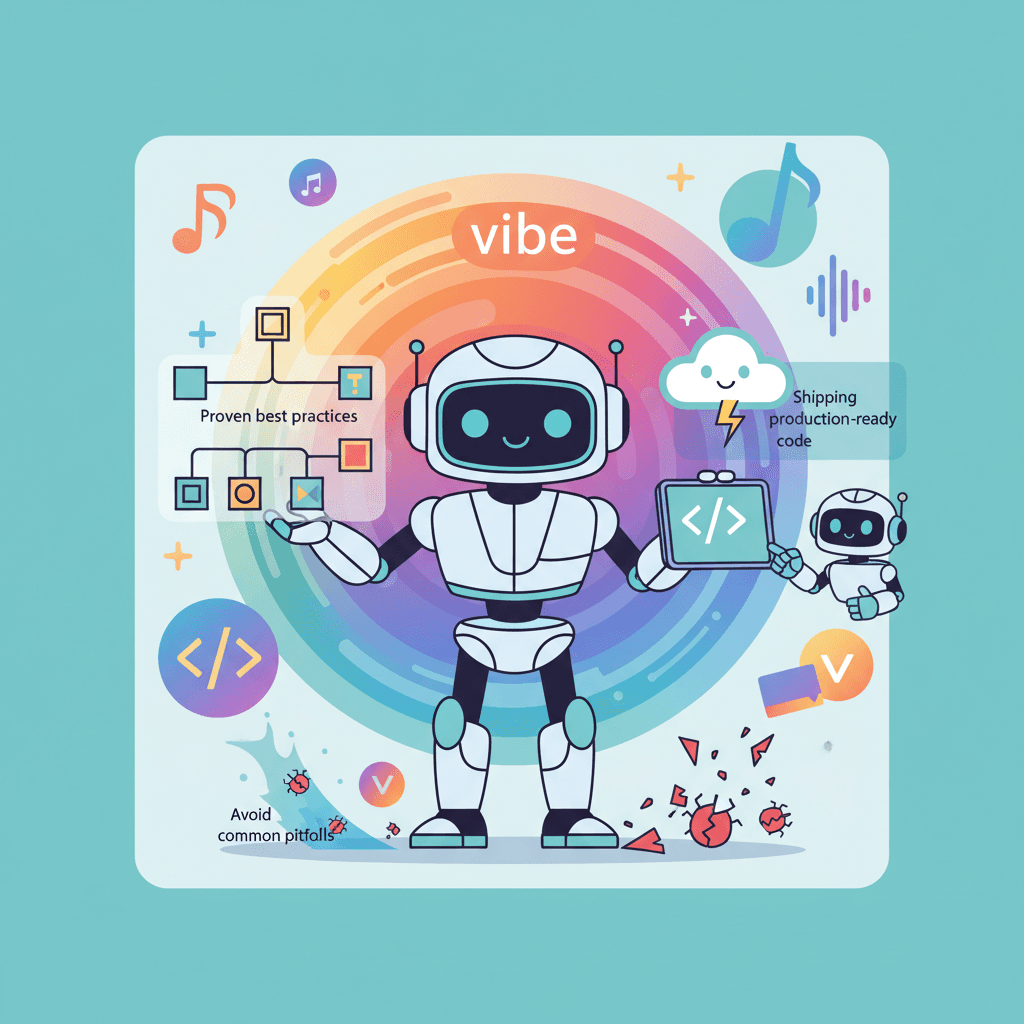
So you've heard about vibe coding. Maybe you've tried it. Maybe you typed something like "build me a todo app" into Cursor or Lovable, watched the AI spit out hundreds of lines of code, and thought—okay, this is either the future or the end of civilization.
Here's the thing: you're not wrong on either count.
Vibe coding has exploded in 2025. A whopping 92% of US developers now use AI coding tools daily, and roughly 41% of all code being written is AI-generated. That's not a trend. That's a fundamental shift in how software gets built.
But here's what nobody wants to admit: most people are doing it wrong. They're either treating AI like a magic wand (spoiler: it's not) or they're so scared of "not really coding" that they're missing out on genuine productivity gains.
This guide is going to fix that. I'm going to walk you through vibe coding best practices that actually work—the techniques that separate developers shipping real products from those drowning in AI-generated spaghetti at 2am.
What is Vibe Coding, Really?
The term "vibe coding" was coined by Andrej Karpathy in February 2025. His original definition? Writing code by describing what you want in natural language and letting AI handle the implementation. You focus on the vibe—the intent, the feel, the outcome—rather than syntax and semicolons.
Collins Dictionary even named it their Word of the Year. That's how mainstream this has become.
But here's my hot take: pure vibe coding is a terrible idea for anything you actually care about.
The original concept involves "fully giving in to the vibes" and "forgetting that the code even exists." Sounds dreamy, right? Until you realize that 45% of AI-generated code contains security vulnerabilities, and you've just deployed something that stores passwords in plain text.
What we need instead is what I call conscious vibe coding—leveraging AI's speed and pattern-matching abilities while maintaining enough understanding to catch problems, guide the AI effectively, and ship code that won't embarrass you (or get you hacked).
The Two Approaches: Choose Your Path
Let's be honest about what we're dealing with here:
| Approach | Pure Vibe Coding | Conscious Vibe Coding |
|---|---|---|
| Philosophy | Accept all AI output | Guide and verify AI output |
| Code Understanding | Optional ("forget the code exists") | Required (understand what matters) |
| Speed | Very fast initially | Fast with sustainable quality |
| Technical Debt | High accumulation | Managed |
| Best For | Quick prototypes, experiments | Production code, real projects |
| Risk Level | High | Low to Medium |
If you're building a weekend project that nobody will ever see? Pure vibe away. But if you're building something for users, clients, or your career? Conscious vibe coding is the only sane approach.
10 Essential Best Practices for Effective Vibe Coding
1. Start With a Spec, Not a Prompt
This is the hill I'll die on: your first prompt should never be code instructions.
Before you ask the AI to write anything, spend 10-15 minutes writing a spec. What are you building? Who is it for? What are the core features vs. nice-to-haves? What should it explicitly not do?
The developers who complain that "AI keeps building the wrong thing" almost always skipped this step. They're playing telephone with a computer, and somehow they're surprised when the message gets garbled.
Here's what a good pre-prompt spec looks like:
Now when you prompt the AI, you're not explaining from scratch. You're collaborating with shared context.
2. Give Rich Context, Get Better Code
Here's a pattern I've noticed: developers will give the AI a one-sentence prompt and then complain for hours about the output. That's like handing someone a blank napkin with "make food" written on it and being upset when they don't make your grandmother's lasagna recipe.
Context is everything. This is why the industry is shifting from "prompt engineering" to "context engineering"—the recognition that what the AI knows about your project matters more than how cleverly you phrase your request.
Feed the AI:
- Your existing code structure
- Your naming conventions
- Your preferred patterns
- Examples of similar code in your project
- Constraints and requirements
Tools like Cursor and Fardino allow you to configure project-level context files (like CLAUDE.md or similar configs) that automatically provide this context. Use them.
3. Work in Small, Testable Chunks
I get it. It's tempting to prompt: "Build me a complete e-commerce platform with user auth, product catalog, shopping cart, checkout, and admin dashboard."
Don't do this. Please.
Large, complex prompts lead to large, complex problems. You'll get thousands of lines of code that mostly works, with a few subtle bugs buried deep enough that you won't find them until a user does.
Instead, break it down:
- User authentication (sign up, login, logout)
- Product listing (display, search, filter)
- Shopping cart (add, remove, update quantities)
- Checkout flow (address, payment, confirmation)
Build each piece. Test it. Understand it. Then move on. Your future self will thank you.
4. Review Everything (Yes, Actually Look at the Code)
I know, I know—if we wanted to read code all day, we wouldn't be vibe coding, right?
Wrong. And honestly? This is the part nobody talks about.
The 44% of engineering leaders reporting declining skills in junior developers who over-rely on AI? That's not because AI is making them lazy. It's because they're not reviewing what the AI produces. They're copy-pasting without comprehension.
You don't need to understand every line. But you should understand:
- The overall structure and flow
- How different components interact
- What dependencies are being used
- Where data is stored and how
- What security measures are (or aren't) in place
Here's a quick code review flow for AI-generated code:
5. Version Control Like Your Career Depends on It
Because sometimes it does.
Commit frequently when vibe coding. More frequently than you think. I'm talking every time the AI produces something that works, even partially.
Why? Because AI can be inconsistent. It might nail something perfectly, then randomly break it when you ask for a small change. Having granular commits means you can always roll back to a working state without losing hours of progress.
My rule: commit before every major prompt. Ask the AI to add a feature? Commit the current state first. This isn't paranoia—it's professionalism.
6. Use the Right Tool for the Job
Not all AI coding assistants are created equal. Here's the reality in late 2025:
| Tool | Best For | Limitations |
|---|---|---|
| Cursor | Code completion, refactoring existing projects | Steeper learning curve |
| Lovable | Full-stack app generation from scratch | Less control over specifics |
| v0 | UI/component generation | Frontend-focused |
| GitHub Copilot | Inline suggestions, pair programming feel | Context window limitations |
| Fardino | Full-stack + Web3 dApp development | Newer platform |
Match the tool to the task. Using Lovable to add a small feature to an existing codebase is like using a sledgehammer to hang a picture frame. It might work, but there are better options.
7. Guard Against Security Vulnerabilities
Here's the scary stat again: 45% of AI-generated code contains security vulnerabilities.
That's not a criticism of AI—it's a recognition that AI models were trained on all the code on the internet, including mountains of insecure code written by developers who didn't know any better.
Critical security checks for AI-generated code:
- SQL injection vulnerabilities (is the AI using parameterized queries?)
- XSS vulnerabilities (is user input being sanitized?)
- Authentication issues (how are sessions being managed?)
- Secrets exposure (are API keys hardcoded anywhere?)
- Dependency risks (what packages are being installed?)
Run static analysis tools. Use security scanners. Or at minimum, ask the AI: "Review this code for security vulnerabilities and show me any concerns."
8. Maintain Your Own Coding Skills
Hot take time: AI won't replace developers, but developers who can't code without AI might become unemployable.
Here's the uncomfortable truth—if you can't recognize when AI makes a mistake, you can't fix it. If you can't understand the code, you can't debug it. If you can't write code yourself, you can't guide the AI effectively.
Vibe coding should augment your skills, not replace them. The best vibe coders I know are people who could write everything themselves but choose to move faster with AI assistance.
So keep learning. Do the occasional project without AI. Understand fundamentals. Future you—the one who needs to debug that AI-generated code at 3am before a major launch—will be grateful.
9. Document as You Go
AI-generated code is often poorly documented. The AI knows what it wrote, but in six months, will you?
Add comments that explain why, not just what. Document your prompts alongside the code—they're part of the development history now. Create README files that explain:
- What the project does
- How to run it
- What dependencies it requires
- What prompts generated key sections
This isn't busy work. It's survival strategy for future maintenance.
10. Know When to Stop and Code Manually
Sometimes the AI just isn't getting it. You've rephrased the prompt five times, provided extensive context, and it's still producing garbage.
Here's a secret the vibe coding evangelists won't tell you: sometimes it's faster to just write the code yourself.
When you've spent more than 15-20 minutes trying to get the AI to do something it keeps fumbling, stop. Write it manually. You'll often solve the problem faster, and you'll understand the solution better.
Common Mistakes That Will Wreck Your Project
Let me save you some painful lessons:
Mistake #1: Accepting the first output. The AI's first attempt is rarely its best. Iterate. Ask for improvements. Request alternatives.
Mistake #2: Ignoring error messages. When something breaks, read the error. Don't just throw it back at the AI hoping for magic. Understand what went wrong.
Mistake #3: Scope creep via prompts. "And also add..." is a dangerous phrase. Keep each prompt focused. Additional features should be additional prompts.
Mistake #4: Treating AI as infallible. It lies. It hallucinates. It confidently produces wrong code. Trust but verify.
Mistake #5: No testing. "It compiles, ship it" is not a testing strategy. Write tests. Run them. AI can help write tests too.
From Vibe Coding to Production: The Bridge
Here's the workflow I use to take vibe-coded prototypes to production:
- Vibe out the prototype — Get something working, don't worry about perfection
- Review and understand — Go through the code, make sure you grasp the structure
- Security audit — Check for common vulnerabilities
- Refactor for quality — Clean up AI patterns that don't match your standards
- Write tests — Cover critical paths and edge cases
- Document — Add the comments and docs you skipped during prototyping
- Deploy carefully — Use staging environments, monitor closely
This process adds time, yes. But it's the difference between shipping a demo and shipping a product.
The Future: Where Vibe Coding Is Heading
If you think things are moving fast now, buckle up. Amazon just announced Kiro, an autonomous coding agent that can work independently for days. Multi-agent systems are becoming more common, with different AI models collaborating on different parts of a project.
The developers who thrive in this environment won't be the ones who blindly accept AI output or those who refuse to use AI at all. It'll be the ones who develop strong collaboration skills with AI tools—who know how to direct, review, and refine AI-generated code effectively.
Vibe coding best practices will keep evolving, but the fundamentals won't change: understand what you're building, communicate clearly with your tools, and never ship code you don't understand.
Ready to Vibe Code Responsibly?
Look, vibe coding isn't going away. It's not a fad. The statistics are clear—this is how a significant portion of code will be written going forward.
But "moving fast" and "maintaining quality" don't have to be enemies. The best practices in this guide aren't about slowing you down—they're about making sure the speed you gain from AI assistance doesn't come back to bite you later.
Start with a clear spec. Provide rich context. Work incrementally. Review everything. And for the love of all things good in software development, commit early and often.
The vibe coding revolution is here. Make sure you're on the right side of it.
Got an idea? Build it now.
Describe the site or app you want — Fardino turns it into a live website.