AI Pricing Table Prompts That Actually Convert
Your pricing table is doing one of two things right now: converting visitors into customers, or watching them bounce. There's no in between. And here's the thing nobody tells you about AI generated pricing tables—most prompts produce generic Bootstrap looking


Your pricing table is doing one of two things right now: converting visitors into customers, or watching them bounce. There's no in-between.
And here's the thing nobody tells you about AI-generated pricing tables—most prompts produce generic Bootstrap-looking garbage that screams "I spent 30 seconds on this." Your visitors can tell. Trust me.
Key Takeaways:
- Generic pricing table prompts fail because they lack specificity about tier structure and visual hierarchy
- The best AI pricing table prompts explicitly define the "recommended" plan styling and toggle behavior
- Mobile responsiveness requires its own prompt section—don't assume the AI will handle it
- Feature comparison tables need structured data formats to generate correctly
In This Article
- Why Most AI Pricing Tables Look the Same
- The Anatomy of a High-Converting Pricing Table
- Basic 3-Tier Pricing Table Prompts
- Feature Comparison Table Prompts
- Monthly vs Annual Toggle Prompts
- Highlighted "Popular" Plan Prompts
- Enterprise & Contact Sales Prompts
- Mobile-Responsive Pricing Prompts
- Common Mistakes (And How to Fix Them)
- FAQ
Why Most AI Pricing Tables Look the Same
Here's my hot take: 90% of AI-generated pricing tables are mediocre because developers write lazy prompts.

"Create a pricing table with three plans" gets you exactly what you deserve—a bland, forgettable component that does nothing for your conversion rate.
The AI isn't the problem. Your prompt is.
When you compare pricing tables that convert against ones that don't, the differences are subtle but crucial:
| High-Converting Tables | Generic AI Output |
|---|---|
| Clear visual hierarchy | All plans look equal |
| Obvious recommended plan | No emphasis anywhere |
| Benefit-focused features | Feature laundry lists |
| Strategic CTA placement | Same button everywhere |
| Trust signals included | No social proof |
If you've been working with AI landing page prompts, you already know that specificity wins. Pricing tables are no different—they're just more unforgiving because they're where the money decision happens.
The Anatomy of a High-Converting Pricing Table
Before I give you the prompts, you need to understand what makes pricing tables work. This isn't theory—this is what I've learned generating dozens of these things.
Every high-converting pricing table has these elements:
- Clear tier differentiation — Users should immediately understand what each plan offers
- Highlighted recommendation — Your mid-tier plan should visually stand out
- Feature hierarchy — Important features at top, nice-to-haves below
- Transparent pricing — No hidden costs, clear monthly/annual options
- Compelling CTAs — Different urgency levels per tier
This is the journey. Your pricing table needs to guide it.
Basic 3-Tier Pricing Table Prompts
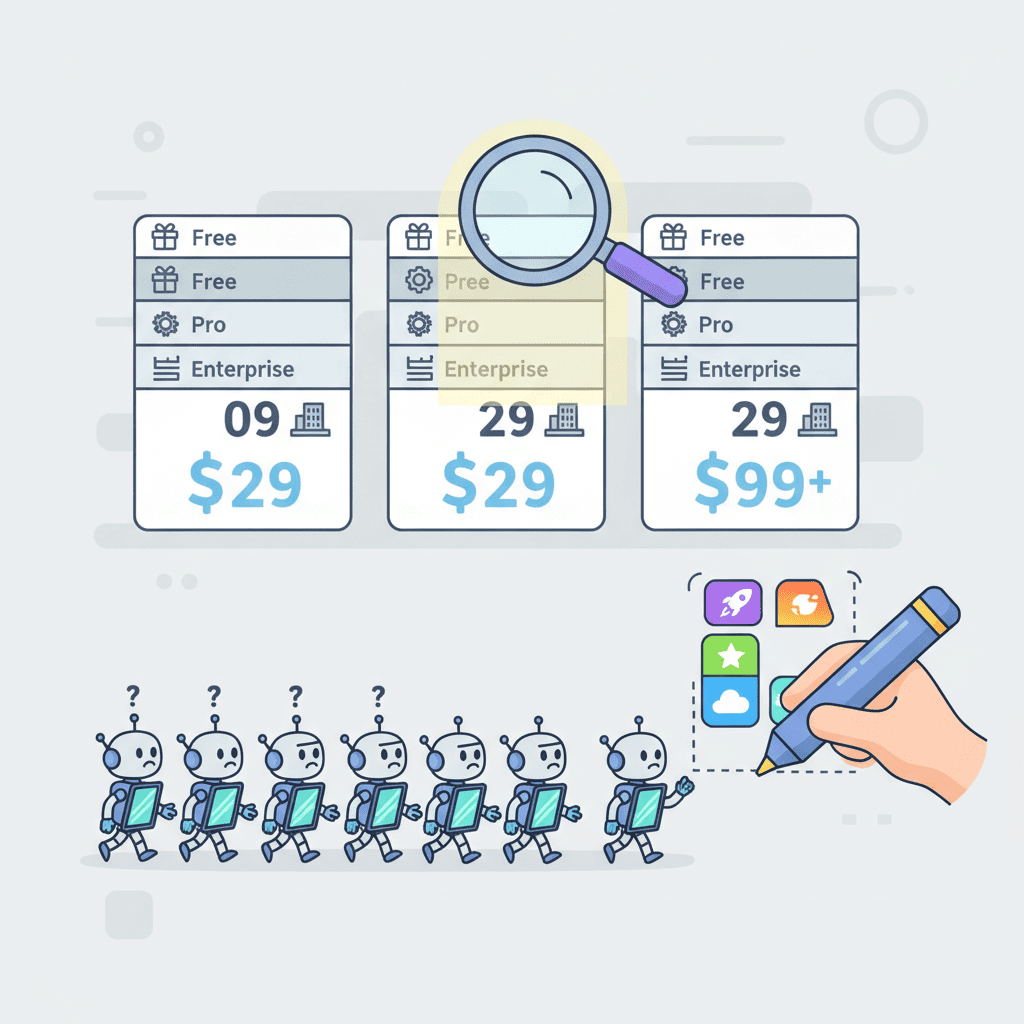
Let's start with the foundation. Here's a prompt that actually generates a professional SaaS pricing table:
Prompt 1: Standard SaaS Pricing Table
This level of detail is what separates prompts that work from prompts that waste your time. Notice I'm specifying the CTA text, button styling, and visual hierarchy for each tier.
Prompt 2: Minimalist Pricing Table
Some products need cleaner aesthetics. Try this:
Want to try this yourself?
Feature Comparison Table Prompts
When your tiers have lots of features, a comparison matrix beats individual cards. Here's how to prompt for those:
Prompt 3: Full Feature Comparison Matrix
The structured data format is crucial here. If you just say "create a comparison table with features," the AI will make up random stuff. Be explicit.
Monthly vs Annual Toggle Prompts
The billing toggle is where many AI pricing tables fall apart. Here's how to get it right:
Prompt 4: Pricing Toggle with Savings Display
This is one of those details that separates amateur pricing pages from professional ones. That "Save 20%" badge? It's doing heavy lifting for your conversions.
If you're building a startup landing page with AI, the pricing section is usually where people spend the most time tweaking. Get the toggle right.
Highlighted "Popular" Plan Prompts
The "recommended" or "popular" plan highlight is non-negotiable for SaaS pricing tables. Most AI outputs don't nail this without explicit instructions.
Prompt 5: Elevated Popular Plan Design
I'll die on this hill: if all three of your pricing cards look identical, you're leaving money on the table. Guide users to the option you want them to pick.
Enterprise & Contact Sales Prompts
Enterprise tiers work differently. You're not showing a price—you're selling a conversation.
Prompt 6: Enterprise Tier with Custom Pricing
Enterprise customers expect different treatment. Your pricing card should reflect that.
Mobile-Responsive Pricing Prompts
Here's where things get tricky. Pricing tables are notoriously hard to make responsive, and AI tools often generate desktop-only garbage.
Prompt 7: Mobile-First Responsive Pricing
I've reviewed hundreds of AI form prompts and the same principle applies—mobile responsiveness doesn't happen automatically. You have to demand it.
Common Mistakes (And How to Fix Them)
After generating way too many pricing tables, here are the mistakes I see constantly:
Mistake 1: Generic Feature Lists
Bad prompt: "Add features to each tier"
Better prompt: "Include these specific features with exact values: 5GB storage, 10 team members, API rate limit 1000 req/min"
The AI needs concrete data. Vague prompts get vague results.
Mistake 2: Forgetting Price Formatting
Bad output: "$29"
Good output: "$29/mo" or "$29 per month, billed annually"
Always specify how prices should display, including billing context.
Mistake 3: Identical CTAs
Bad prompt: "Add a button to each plan"
Better prompt: "Free tier: 'Get Started', Pro tier: 'Start Free Trial', Enterprise: 'Contact Sales'"
Different tiers need different calls to action. The urgency and commitment level varies.
Mistake 4: No Visual Hierarchy
If you don't explicitly ask for a highlighted plan, you'll get three identical cards. Every. Single. Time.
Mistake 5: Ignoring Trust Elements
Add to your prompts:
- "Include 'No credit card required' under free tier CTA"
- "Add '14-day free trial' badge"
- "Show 'Trusted by 10,000+ teams' social proof"
These elements matter for conversion rates.
Try It Yourself
Here's a comprehensive prompt you can paste directly:
Want to try this yourself?
If you want to see how these pricing tables fit into a complete landing page, check out our guide on vibe coding best practices. The same principles apply—specificity and structure beat generic prompts every time.
You Might Also Like
- AI Landing Page Prompts: 50+ Templates That Actually Work - Complete your landing page with hero sections, feature grids, and more
- Build a Startup Landing Page with AI - End-to-end guide for shipping landing pages fast
- AI E-commerce UI Prompts That Actually Sell - Product pages, carts, and checkout flows that convert
Frequently Asked Questions
What makes a good AI pricing table prompt?
Specificity. Include exact prices, feature lists, visual hierarchy preferences (which plan to highlight), button text for each tier, and responsive behavior. Generic prompts like "create a pricing table" produce generic results.
How do I make the AI highlight one pricing plan over others?
Explicitly state which plan should be featured and describe the visual treatment: "MARK PRO AS MOST POPULAR with elevated card, colored border, larger shadow, and 'Recommended' badge." The AI won't make these decisions for you.
Should I use monthly or annual pricing as the default?
Default to annual if you offer a discount—it's what you want users to see first. Include a toggle and show the savings ("Save 20%") to encourage annual commits. Always show the monthly equivalent for annual plans.
How do I make AI pricing tables mobile-responsive?
Add explicit mobile breakpoints to your prompt. Specify "stack vertically on mobile," "use full-width cards below 768px," and "ensure touch targets are 44px minimum." Don't assume the AI handles responsive design automatically.
What's the best number of pricing tiers?
Three tiers work best for most SaaS products—a free/cheap option (anchor), a recommended middle tier (target), and a premium option (makes middle look reasonable). More than four creates decision fatigue.
Written by the Fardino Team. We build AI tools for frontend developers. Build with Fardino →
Got an idea? Build it now.
Describe the site or app you want — Fardino turns it into a live website.